From Zero Hedge:
The time for more insanity has come... It is the Keynesian mantra: the fact that the policies recommended by Keynesians and monetarists, i.e., deficit spending and money printing, routinely fail to bring about the desired results is not seen as proof that they simply don’t work. It is regarded as evidence that there hasn’t been enough spending and printing yet.
http://www.zerohedge.com/news/2016-01-30/pandoras-box-open-db-warns-japan-may-have-started-silent-bank-run
Showing posts with label Japan. Show all posts
Showing posts with label Japan. Show all posts
Saturday, January 30, 2016

"Pandora's Box Is Open": Why Japan May Have Started A 'Silent Bank Run'
From Zero Hedge:
if the negative interest rate continues for longer or goes deeper, commercial banks may have to set negative interest rates on deposits, which would expand not only the tax on commercial banks, but also on depositors (households and companies). This could lead to a ‘silent bank run’ via a shift of deposits to cash (banknotes), which in turn damages the sound banking system by enlarging the leakage of funds from the credit creation mechanism in the banking system."
http://www.zerohedge.com/news/2016-01-30/pandoras-box-open-db-warns-japan-may-have-started-silent-bank-run
if the negative interest rate continues for longer or goes deeper, commercial banks may have to set negative interest rates on deposits, which would expand not only the tax on commercial banks, but also on depositors (households and companies). This could lead to a ‘silent bank run’ via a shift of deposits to cash (banknotes), which in turn damages the sound banking system by enlarging the leakage of funds from the credit creation mechanism in the banking system."
http://www.zerohedge.com/news/2016-01-30/pandoras-box-open-db-warns-japan-may-have-started-silent-bank-run
Sunday, November 15, 2015
For The First Time Ever, Japan Enters A Quintuple-Dip Recession (Courtesy Of Abenomics)
From Zero Hedge:
For The First Time Ever, Japan Enters A Quintuple-Dip Recession (Courtesy Of Abenomics)
Because nothing says 'successful monetary policy' like 5 'technical' recessions in 5 years...
Japan 3Q GDP Falls Annualized 0.8% Q/q; Est. -0.2%

As if this was not bad enough, Japanese business spending dropped 1.3% QoQ - its worst drop since Q2 2014...
And finally - what is working...

Charts: Bloomberg
http://www.zerohedge.com/news/2015-11-15/first-time-ever-japan-enters-quintuple-dip-recession-courtesy-abenomics
For The First Time Ever, Japan Enters A Quintuple-Dip Recession (Courtesy Of Abenomics)
Because nothing says 'successful monetary policy' like 5 'technical' recessions in 5 years...
Japan 3Q GDP Falls Annualized 0.8% Q/q; Est. -0.2%

As if this was not bad enough, Japanese business spending dropped 1.3% QoQ - its worst drop since Q2 2014...
And finally - what is working...

Charts: Bloomberg
http://www.zerohedge.com/news/2015-11-15/first-time-ever-japan-enters-quintuple-dip-recession-courtesy-abenomics
Tuesday, October 20, 2015
South Korea should not shake alliance with U.S. by favoring China too much
From The Yomiuri Shimbun:
It is vital that the United States and South Korea maintain their solid alliance, for the deterrence of North Korea’s military provocations and the regional stability of Asia. South Korea should not weaken these ties by getting too close to China.
U.S. President Barack Obama held talks with his South Korean counterpart Park Geun-hye in Washington and they adopted a joint statement focusing on their cooperation to get Pyongyang to abandon its nuclear and missile programs.
The statement warns that additional sanctions will be imposed on Pyongyang should the country push through with launching a ballistic missile or conducting a nuclear test in violation of U.N. Security Council resolutions.
http://the-japan-news.com/news/article/0002502005
It is vital that the United States and South Korea maintain their solid alliance, for the deterrence of North Korea’s military provocations and the regional stability of Asia. South Korea should not weaken these ties by getting too close to China.
U.S. President Barack Obama held talks with his South Korean counterpart Park Geun-hye in Washington and they adopted a joint statement focusing on their cooperation to get Pyongyang to abandon its nuclear and missile programs.
The statement warns that additional sanctions will be imposed on Pyongyang should the country push through with launching a ballistic missile or conducting a nuclear test in violation of U.N. Security Council resolutions.
http://the-japan-news.com/news/article/0002502005
Tuesday, August 25, 2015
The Ghost Of 1997 Beckons, Can Asia Escape? Morgan Stanley, BofA Weigh In
From Zero Hedge:
The similarities between the current crisis and that which unfolded in 1997/98 were so readily apparent that many analysts began to draw comparisons and that may have added fuel to fire over the past week. Now, there seems to be a concerted effort to calm the market by explaining that while there are similarities, there are also differences. And while some of the world's imperiled EM economies may be in better shape to defend themselves this time around, when attempting to cope with a meltdown it may be more important to look at where things are similar and on that note, here’s some color from Morgan Stanley and BofAML.

http://www.zerohedge.com/news/2015-08-24/ghost-1997-beckons-can-asia-escape-morgan-stanley-bofa-weigh
The similarities between the current crisis and that which unfolded in 1997/98 were so readily apparent that many analysts began to draw comparisons and that may have added fuel to fire over the past week. Now, there seems to be a concerted effort to calm the market by explaining that while there are similarities, there are also differences. And while some of the world's imperiled EM economies may be in better shape to defend themselves this time around, when attempting to cope with a meltdown it may be more important to look at where things are similar and on that note, here’s some color from Morgan Stanley and BofAML.

http://www.zerohedge.com/news/2015-08-24/ghost-1997-beckons-can-asia-escape-morgan-stanley-bofa-weigh
Sunday, July 26, 2015
Abenomics End Game: Thousands Protest In Downtown Tokyo, Demand Abe's Resignation As PM Disapproval Soars
From Zero Hedge:
Years of growing resentment for the Japanese premier, who panders only to the rich, to the exporting corporations, to the Japanese military-industrial complex, and of course, to the US government and Goldman Sachs (whose idea Abenomics was from the very beginning) thousands of protestors rallied Friday night in downtown Tokyo in a campaign of "Say no to the Abe government," targeting Japanese Prime Minister Shinzo Abe's "runaway" policy. The protestors gathered at the Hibiya Park, Diet building and the prime minister's official residence, shouting "Abe step down."
http://www.zerohedge.com/news/2015-07-25/abenomics-end-game-thousands-protest-downtown-tokyo-demand-abes-resignation-pm-disap
Years of growing resentment for the Japanese premier, who panders only to the rich, to the exporting corporations, to the Japanese military-industrial complex, and of course, to the US government and Goldman Sachs (whose idea Abenomics was from the very beginning) thousands of protestors rallied Friday night in downtown Tokyo in a campaign of "Say no to the Abe government," targeting Japanese Prime Minister Shinzo Abe's "runaway" policy. The protestors gathered at the Hibiya Park, Diet building and the prime minister's official residence, shouting "Abe step down."
http://www.zerohedge.com/news/2015-07-25/abenomics-end-game-thousands-protest-downtown-tokyo-demand-abes-resignation-pm-disap
Thursday, July 16, 2015
Japan's Economic Disaster: Real Wages Lowest Since 1990, Record Numbers Describe "Hard" Living Conditions
From Zero Hedge:
With so much attention rightly focused on China at the moment, people aren’t paying enough attention to the budding economic calamity unfolding in Japan. While “Abenomics” has succeeded in boosting the stock market and food prices, it has utterly failed to raise wages. In fact, wages adjusted for inflation have plunged to the lowest since 1990. As such, a record number of households now describe their living conditions as “somewhat hard” or “very hard.”

http://www.zerohedge.com/news/2015-07-15/japans-economic-disaster-real-wages-lowest-1990-record-numbers-describe-hard-living-
With so much attention rightly focused on China at the moment, people aren’t paying enough attention to the budding economic calamity unfolding in Japan. While “Abenomics” has succeeded in boosting the stock market and food prices, it has utterly failed to raise wages. In fact, wages adjusted for inflation have plunged to the lowest since 1990. As such, a record number of households now describe their living conditions as “somewhat hard” or “very hard.”
http://www.zerohedge.com/news/2015-07-15/japans-economic-disaster-real-wages-lowest-1990-record-numbers-describe-hard-living-
Tuesday, June 2, 2015
From Money To Psychology, Japan Reveals The Basis Of Economic Policy Corruption
From Zero Hedge:
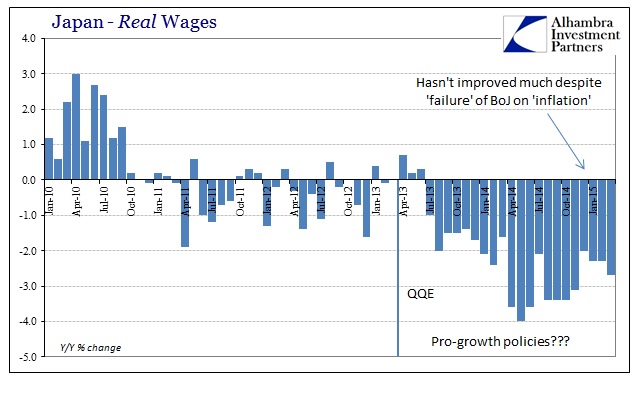
At some point in the middle of the last century, economics of money shifted to economics of psychology. Abenomics is the perfect example of this faith-based policy. The Japanese economy, to any clear mind, took a huge turn for the worst under Abenomics yet its practitioners are still, somehow, given the final word on judging its performance, meaning that the mainstream still, somehow, subscribes to the religion.
Instead, in what matters most, real wages have shown absolutely no tendency toward everything that was expected. When starting QQE more than two years ago, it was fully intended that by now real wages would not just be rising but rising steadily and robustly. Japanese workers have suffered the opposite.

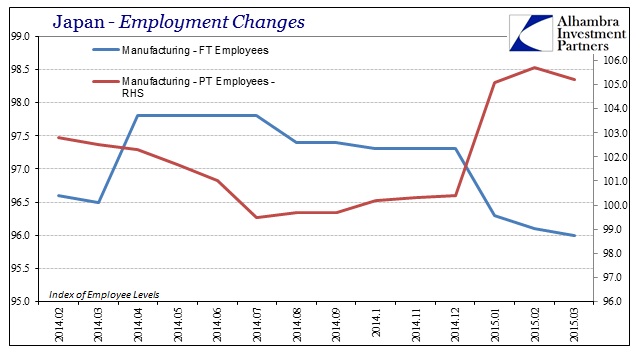
The reason for that is the very way in which the unemployment rate is misleadingly “happy”, connecting wages to what really looks like a still-gathering recession. In the past few months, when this post-tax recovery was supposed to materialize, Japanese businesses have been degrading their labor force, shifting a huge proportion at the margins out of full-time and into part-time. The Japanese still don’t do mass layoffs, instead they just cut hours strenuously while maintaining the “happy” unemployment rate.

http://www.zerohedge.com/news/2015-06-01/money-psychology-japan-reveals-basis-economic-policy-corruption
At some point in the middle of the last century, economics of money shifted to economics of psychology. Abenomics is the perfect example of this faith-based policy. The Japanese economy, to any clear mind, took a huge turn for the worst under Abenomics yet its practitioners are still, somehow, given the final word on judging its performance, meaning that the mainstream still, somehow, subscribes to the religion.
Instead, in what matters most, real wages have shown absolutely no tendency toward everything that was expected. When starting QQE more than two years ago, it was fully intended that by now real wages would not just be rising but rising steadily and robustly. Japanese workers have suffered the opposite.
The reason for that is the very way in which the unemployment rate is misleadingly “happy”, connecting wages to what really looks like a still-gathering recession. In the past few months, when this post-tax recovery was supposed to materialize, Japanese businesses have been degrading their labor force, shifting a huge proportion at the margins out of full-time and into part-time. The Japanese still don’t do mass layoffs, instead they just cut hours strenuously while maintaining the “happy” unemployment rate.
http://www.zerohedge.com/news/2015-06-01/money-psychology-japan-reveals-basis-economic-policy-corruption
Sunday, May 24, 2015
"New Silk Road" Could Change Global Economics Forever
From Zero Hedge:
China is building the world’s greatest economic development and construction project ever undertaken: The New Silk Road. The project aims at no less than a revolutionary change in the economic map of the world. It is also seen by many as the first shot in a battle between east and west for dominance in Eurasia. For the world at large, its decisions about the Road are nothing less than momentous. The massive project holds the potential for a new renaissance in commerce, industry, discovery, thought, invention, and culture that could well rival the original Silk Road. It is also becoming clearer by the day that geopolitical conflicts over the project could lead to a new cold war between East and West for dominance in Eurasia.
A look at the first project, currently under development, provides a good example of how China plans to proceed.

http://www.zerohedge.com/news/2015-05-23/new-silk-road-could-change-global-economics-forever-part-1
China is building the world’s greatest economic development and construction project ever undertaken: The New Silk Road. The project aims at no less than a revolutionary change in the economic map of the world. It is also seen by many as the first shot in a battle between east and west for dominance in Eurasia. For the world at large, its decisions about the Road are nothing less than momentous. The massive project holds the potential for a new renaissance in commerce, industry, discovery, thought, invention, and culture that could well rival the original Silk Road. It is also becoming clearer by the day that geopolitical conflicts over the project could lead to a new cold war between East and West for dominance in Eurasia.

http://www.zerohedge.com/news/2015-05-23/new-silk-road-could-change-global-economics-forever-part-1
Sunday, May 10, 2015
A Multinational Trojan Horse: The Trans-Pacific Partnership
From Zero Hedge:
Peel back the layers of the TPP and you’ll find what some believe to be a “corporate Trojan horse.” Disguised as “free trade,” the TPP’s provisions and tactics undermine Constitutional safeguards and national sovereignty. But there’s also a silver lining. The TPP exposes who, in the marbled halls of political power, is working for whom. It forces politicians to put their cards on the table, and by their hands you will know them. Packaged as a gift to the American people that will renew industry and make us more competitive, the Trans-Pacific Partnership is a Trojan horse. It’s a coup by multinational corporations who want global subservience to their agenda. Buyer beware. Citizens beware.
http://www.zerohedge.com/news/2015-05-09/multinational-trojan-horse-trans-pacific-partnership
Peel back the layers of the TPP and you’ll find what some believe to be a “corporate Trojan horse.” Disguised as “free trade,” the TPP’s provisions and tactics undermine Constitutional safeguards and national sovereignty. But there’s also a silver lining. The TPP exposes who, in the marbled halls of political power, is working for whom. It forces politicians to put their cards on the table, and by their hands you will know them. Packaged as a gift to the American people that will renew industry and make us more competitive, the Trans-Pacific Partnership is a Trojan horse. It’s a coup by multinational corporations who want global subservience to their agenda. Buyer beware. Citizens beware.
http://www.zerohedge.com/news/2015-05-09/multinational-trojan-horse-trans-pacific-partnership
Thursday, April 30, 2015
Satyajit Das: Two Views of Japan’s Setting Sun
Similarities are so there.
From Naked Capitalism:
Das discusses two recent books on Japan, and both provide windows on how Japan is coping with its now lost two decades. One of them is by Tag Murphy, who I met in my days in Japan and has long been a very insightful commentator. As I said at the Atlantic Economy conference, rather than trying to “jump start the economy,” which would take more radical restructuring than they are willing to engage in, the top wealthy might be better served to worry about managing low growth better. And for its many flaws, egalitarian Japan has muddled through a far more severe bubble and bust with more grace than we have.
http://www.nakedcapitalism.com/2015/04/satyajit-das-two-views-japans-setting-sun.html
From Naked Capitalism:
Das discusses two recent books on Japan, and both provide windows on how Japan is coping with its now lost two decades. One of them is by Tag Murphy, who I met in my days in Japan and has long been a very insightful commentator. As I said at the Atlantic Economy conference, rather than trying to “jump start the economy,” which would take more radical restructuring than they are willing to engage in, the top wealthy might be better served to worry about managing low growth better. And for its many flaws, egalitarian Japan has muddled through a far more severe bubble and bust with more grace than we have.
http://www.nakedcapitalism.com/2015/04/satyajit-das-two-views-japans-setting-sun.html
Wednesday, April 15, 2015
America, Meet Your Brand New Largest Foreign Creditor
The U.S. and East Asian countries including Korea have fed off each other.
From Zero Hedge:
Exactly one month ago we wrote that "Japan Ties China As America's Largest Creditor" when, according to Treasury International Capital in the month of January, China sold just over $5 billion in Treasurys while Japan bought $8 billion in US paper. Fast forward to today when we are pleased to announce that, as expected, the trend has continued and for the first time since the great financial crisis, Japan is once again America's largest foreign credito.

http://www.zerohedge.com/news/2015-04-15/america-meet-your-brand-new-largest-foreign-creditor
From Zero Hedge:
Exactly one month ago we wrote that "Japan Ties China As America's Largest Creditor" when, according to Treasury International Capital in the month of January, China sold just over $5 billion in Treasurys while Japan bought $8 billion in US paper. Fast forward to today when we are pleased to announce that, as expected, the trend has continued and for the first time since the great financial crisis, Japan is once again America's largest foreign credito.
http://www.zerohedge.com/news/2015-04-15/america-meet-your-brand-new-largest-foreign-creditor
Tuesday, March 31, 2015
Wages Around The World
From Zero Hedge:

But minimum wages around the world vary dramatically...

MIT professor Erik Brynjolfsson, author of Race Against the Machines and The Second Machine Age, argues that technology is fundamentally changing labor markets and increasingly displacing higher-skill, higher-wage workers. He is hopeful, however, that a new approach to education as well as entrepreneurship can result in new industries that “not only create value for consumers, but also leverage a lot of people and put them to work in new ways.”

Source: Goldman Sachs
http://www.zerohedge.com/news/2015-03-29/wages-around-world

But minimum wages around the world vary dramatically...

MIT professor Erik Brynjolfsson, author of Race Against the Machines and The Second Machine Age, argues that technology is fundamentally changing labor markets and increasingly displacing higher-skill, higher-wage workers. He is hopeful, however, that a new approach to education as well as entrepreneurship can result in new industries that “not only create value for consumers, but also leverage a lot of people and put them to work in new ways.”
"Median incomes are stagnating and have even fallen since the 1990s. And there is no doubt in my mind that technology is a big part of that." - Erik BrynolfsonOf course, for much of Europe, none of that matters as the worker is much more protcted than the average American...

Source: Goldman Sachs
http://www.zerohedge.com/news/2015-03-29/wages-around-world
Wednesday, March 25, 2015
This Is What The Global Economy Got For $11,000,000,000,000 In QE
The point of the following post applies to Korea as well. QE and lowering interest rate have replaced the dwindling income, kicking the can down the road. The authorities of Korea are aware of this. The lack of accountability and moral obligation can bring another crisis down the line. As this post points out, the cases of the U.S. and Japan show that QE has failed in boosting the real economy.
From Zero Hedge:


http://www.zerohedge.com/news/2015-03-24/what-global-economy-got-11000000000000-qe
From Zero Hedge:
Eleven trillion dollars: that’s how much of so-called Quantitative Easing the world’s central banks have done since the 2008 crisis. To put that in perspective, with eleven trillion dollars you could pay off pretty much all U.S. household debt – all mortgages, all car and student loans, credit cards – you name it.
So what did the global economy get for $11,000,000,000,000 in QE?

Following a post-recession pop, we got collapsing world trade growth, and that’s even with prices falling over the past three to four years.
Why is this happening?

It’s not because this time around things are different. To the contrary, the song remains the same.
For a long time, nearly four decades, growth has been getting progressively weaker during each recovery from recession. Of course, the U.S. is a major contributor to world trade and QE, but its trend of weaker growth is present in all major developed economies.
Japan, with its “lost decades,” is at the leading edge of this long-term trend. But make no mistake, Europe, and as we see, even the U.S., are not far behind. Knowing this, will a trillion or so of more QE from the ECB make the trends in these charts turn and go the other way?
http://www.zerohedge.com/news/2015-03-24/what-global-economy-got-11000000000000-qe
Monday, March 16, 2015
Japan Ties China As America's Largest Creditor As Foreigners Dump A Record Amount Of Treasurys
Why have Japan, Korea, and China purchased the U.S. treasury (i.e., debt) in the first place? I have touched upon this issue several times. Their economic miracle was the delusion in some sense.
From Zero Hedge:
Moments ago the January TIC data update was released, and while China continued selling US paper, liquidating another $5.2 billion in January and bringing its new total to the lowest since January 2013, Japan - yes that Japan whose central bank is now moentizing 100% of its own debt issuance because the country is now effectively insolvent and absent constant monetization of its debt it is finished - bought $8 billion in US debt, in the process trying China as America's largest foreign creditor for the first time in history, with both nations holdings $1.239 trillion in US TSYs.

http://www.zerohedge.com/news/2015-03-16/japan-ties-china-americas-largest-creditor-foreigners-dump-record-amount-treasurys
From Zero Hedge:
Moments ago the January TIC data update was released, and while China continued selling US paper, liquidating another $5.2 billion in January and bringing its new total to the lowest since January 2013, Japan - yes that Japan whose central bank is now moentizing 100% of its own debt issuance because the country is now effectively insolvent and absent constant monetization of its debt it is finished - bought $8 billion in US debt, in the process trying China as America's largest foreign creditor for the first time in history, with both nations holdings $1.239 trillion in US TSYs.

http://www.zerohedge.com/news/2015-03-16/japan-ties-china-americas-largest-creditor-foreigners-dump-record-amount-treasurys
Wednesday, March 11, 2015
Plunge Protection Exposed: Bank Of Japan Stepped In A Stunning 143 Times To Buy Stocks, Prevent Drop
From Zero Hedge:
As The Wall Street Journal reports,

http://www.zerohedge.com/news/2015-03-11/how-boj-stepped-143-times-send-japanese-stocks-soaring
The BoJ has now gone full intervention-tard - buying Japanese stocks on 76% of the days when the market opened lower.
As The Wall Street Journal reports,
The Bank of Japan’s aggressive purchasing of stock funds has helped Japanese shares climb to multiyear highs in recent months. But some within the central bank are growing uncomfortable about the fast-paced rally and the bank’s own role in fueling it.
Since Gov. Haruhiko Kuroda took office in March 2013 and introduced monetary easing of what he called a “different dimension,” the central bank has sharply increased its buying of baskets of stocks known as exchange-traded funds. By directly underpinning the market, officials have tried to encourage private investors to follow suit and put more money in stocks in the hope of stimulating the economy and increasing inflation.
During the past two years, the central bank entered the stock market roughly once every three days, picking up a total of ¥2.8 trillion ($23 billion) of ETFs that track Japan’s major stock indexes, according to Bank of Japan records. That distinguishes it from the U.S. Federal Reserve and European Central Bank, both of which have bought bonds to pump up the economy but haven’t directly bought stocks.
Analysts say the bank’s action has been a significant driver of Japan’s stock-market rally in recent months, combined with hefty purchases by the $1.1 trillion Government Pension Investment Fund. Their buying has often countered selling pressure from individuals in the market and made up for a weaker appetite among foreign investors.

The central bank has stepped in mostly when market sentiment was weak. Three-quarters of the central bank’s buying occurred on days when the benchmark Topix index opened lower, according to a Wall Street Journal analysis of BOJ data.

So much for independence...
http://www.zerohedge.com/news/2015-03-11/how-boj-stepped-143-times-send-japanese-stocks-soaring
Thursday, March 5, 2015
Japan Now Spends 43% Of Tax Revenue To Fund Interest On Debt
From Zero Hedge:
Throughout history governments have often overestimated how much their citizens are willing to accept. Japan has a beautiful stoic culture that has been able to endure tremendous suffering. That said, everyone has a breaking point. And that’s when you see that there’s a big difference between love of country and love of government. Bottom line - it’s already starting to unravel.
http://www.zerohedge.com/news/2015-03-05/japan-now-spends-43-tax-revenue-fund-interest-debt
Throughout history governments have often overestimated how much their citizens are willing to accept. Japan has a beautiful stoic culture that has been able to endure tremendous suffering. That said, everyone has a breaking point. And that’s when you see that there’s a big difference between love of country and love of government. Bottom line - it’s already starting to unravel.
http://www.zerohedge.com/news/2015-03-05/japan-now-spends-43-tax-revenue-fund-interest-debt
Monday, February 23, 2015
The most indebted countries in the world and how they got into
From Zero Hedge:
If anyone has stopped to ask just why global central banks are in such a rush to create inflation (but only controlled inflation, not runaway hyperinflation... of course when they fail with the "controlled" part the money paradrop is only a matter of time) over the past 5 years, and have printed over $12 trillion in credit-money since Lehman, the bulk of which has ended up in the stock market, and which for the first time ever are about to monetize all global sovereign debt issuance in 2015, the answer is simple, and can be seen on the chart below.
It also shows the biggest problem facing the world today, namely that at least 9 countries have debt/GDP above 300%, and that a whopping 39% countries have debt-to-GDP of over 100%!

We have written on this topic on countless occasions in the past, so we will be brief: either the Fed inflates this debt away, or one can kiss any hope of economic growth goodbye, even if that means even more central bank rate cuts, more QEs everywhere, and stock markets trading at +? while the middle class around the globe disappears and only the 0.001% is left standing.
Finally, those curious just how the world got to this unprecedented and sorry state, this full breakdown courtesy of McKinsey should answer all questions.

http://www.zerohedge.com/news/2015-02-23/biggest-problem-facing-world-today-9-countries-have-debt-gdp-over-300
If anyone has stopped to ask just why global central banks are in such a rush to create inflation (but only controlled inflation, not runaway hyperinflation... of course when they fail with the "controlled" part the money paradrop is only a matter of time) over the past 5 years, and have printed over $12 trillion in credit-money since Lehman, the bulk of which has ended up in the stock market, and which for the first time ever are about to monetize all global sovereign debt issuance in 2015, the answer is simple, and can be seen on the chart below.
It also shows the biggest problem facing the world today, namely that at least 9 countries have debt/GDP above 300%, and that a whopping 39% countries have debt-to-GDP of over 100%!

We have written on this topic on countless occasions in the past, so we will be brief: either the Fed inflates this debt away, or one can kiss any hope of economic growth goodbye, even if that means even more central bank rate cuts, more QEs everywhere, and stock markets trading at +? while the middle class around the globe disappears and only the 0.001% is left standing.
Finally, those curious just how the world got to this unprecedented and sorry state, this full breakdown courtesy of McKinsey should answer all questions.
http://www.zerohedge.com/news/2015-02-23/biggest-problem-facing-world-today-9-countries-have-debt-gdp-over-300
Monday, January 19, 2015
Richard Koo Crushes The QE Dream
Although to a different degree, this can apply to the monetary policy of Korea. Korea should learn from Japan's policy undertaking and its consequences.
From Zero Hedge:
From Zero Hedge:
Late on Friday afternoon, desparate to relive his mid-October 'world-saving' heroics, The Fed's Jim Bullard unleashed some more Fedspeak aimed at the promise of moar money to save the world (i.e. stocks) if things don't work out. But it is his concluding comment that sparked the most 'keyboard-smashing-angst' for those not buying the spoon-fed omnipotence of the central planners. Bullard stated unequivocally that "the lesson of QE is that it works fairly well." While we are not exactly sure what his definition of 'works' is, as the chart below and Richard Koo's QE-dream-crushing commentary shows, by reflating assets by their hand, the central planners are putting the cart before the horse... and Japan is a perfect example of the vicious economic spiral that leads to...
First, let's look at how well QE has worked...

As Richard Koo explains...there is a loss of confidence in Japan’s growth potential:
So there we have it... clear as crystal in words and pictures - printing money to reflate assets in the hope it boosts the economy is fallacious at best and utterly disastrous at worst.
http://www.zerohedge.com/news/2015-01-17/richard-koo-crushes-qe-dream-1-brief-paragraph
First, let's look at how well QE has worked...
- *BULLARD SAYS LESSON OF QE IS IT WORKS 'FAIRLY WELL'

As Richard Koo explains...there is a loss of confidence in Japan’s growth potential:
Have people recognized how unreasonable the reflationists’ arguments are?The percentage seeing “greater potential to grow” slipped from 3.3% in June to 3.1% in September and just 2.9% in December.
Meanwhile, the percentage who think the economy has “less potential to grow” rose from 46.1% in June to 49.2% in September and 53.4% in December.
* * *Mr. Kuroda and his fellow reflationists in academia have argued that if the portfolio rebalancing effect of quantitative easing pushes up asset prices, the owners of those assets will grow richer and spend more money, thereby boosting the economy.
Ordinarily, it is improvements in an economy’s growth potential that boost asset prices by enhancing the expected profitability of those assets.
In the BOJ’s scenario, however, it is the central bank that forces asset prices higher to enhance the economy’s growth potential.
I think the survey findings confirm a realization among the general public that there is a fundamental problem with that argument, that the BOJ is putting the cart before the horse.
So there we have it... clear as crystal in words and pictures - printing money to reflate assets in the hope it boosts the economy is fallacious at best and utterly disastrous at worst.
http://www.zerohedge.com/news/2015-01-17/richard-koo-crushes-qe-dream-1-brief-paragraph
Friday, January 16, 2015
Japan Set To Surpass China As America's Largest Creditor
Again, one needs to look into geopolitical issues to understand Asian Tigers' rapid economic rise, especially its unique relationship with the U.S. Why Japan, Korea, and China have bought U.S. treasuries (i.e., U.S. debt) in the first place?
From Zero Hedge:
When it comes to America's foreign creditors, only two names matter (except for Belgium whose Euroclear service continues to be used by an anonymous entity(s) to buy up US Treasurys): Japan and China. And it is in the Treasury buying and selling dynamics of these two entities that we can see how Japan's monetary policy has impacted its holdings of US paper, which just hit a new all time high of $1,242 billion, while on the other hand Beijing's official holdings of Treasurys have remained unchanged since the summer of 2011, and which in July declined yet another month to just $1,250 billion, the lowest since January 2013.
In fact, as the chart below shows, thanks to Abenomics, in the past two years Japan's holdings of US paper have soared by $150 billion, as the BOJ has forced pension funds, banks and citizens to chase higher yielding US paper, while Chinese holdings haven't budged by an inch.

At this rate, look for a historic inversion next month when the December TIC data is released and which, all else equal, will show that for the first time since the financial crisis, China will no longer be America's largest creditor, a spot that will be taken over by insolvent Japan.
Yes, the same Japan which as we showed before, is forced to monetize all of its own gross treasury issuance or else suffer a completely bond market collapse.
http://www.zerohedge.com/news/2015-01-16/japan-set-surpass-china-americas-largest-creditor
From Zero Hedge:
When it comes to America's foreign creditors, only two names matter (except for Belgium whose Euroclear service continues to be used by an anonymous entity(s) to buy up US Treasurys): Japan and China. And it is in the Treasury buying and selling dynamics of these two entities that we can see how Japan's monetary policy has impacted its holdings of US paper, which just hit a new all time high of $1,242 billion, while on the other hand Beijing's official holdings of Treasurys have remained unchanged since the summer of 2011, and which in July declined yet another month to just $1,250 billion, the lowest since January 2013.
In fact, as the chart below shows, thanks to Abenomics, in the past two years Japan's holdings of US paper have soared by $150 billion, as the BOJ has forced pension funds, banks and citizens to chase higher yielding US paper, while Chinese holdings haven't budged by an inch.

At this rate, look for a historic inversion next month when the December TIC data is released and which, all else equal, will show that for the first time since the financial crisis, China will no longer be America's largest creditor, a spot that will be taken over by insolvent Japan.
Yes, the same Japan which as we showed before, is forced to monetize all of its own gross treasury issuance or else suffer a completely bond market collapse.
http://www.zerohedge.com/news/2015-01-16/japan-set-surpass-china-americas-largest-creditor
Subscribe to:
Posts (Atom)